General
What is Satisfactory Academic Progress (SAP)?
UMBC is required to monitor its student’s academic progress to ensure that they maintain a minimum standard GPA and make steady progress toward degree completion. Students who do not meet SAP standards may lose their financial aid eligibility.
What is included when determining progress?
SAP includes all credit hours classes attempted where the following grades were earned: A, B, C, D, F, I, P, S, U, W, WX and all grades earned each time a course was repeated. Grades received for remedial, ESL, academic amnesty, and institutional credit courses are included in the number of attempted credits, but are not included in your GPA. Credit hours attempted in each semester that you enroll will be counted, even the semesters when you do not receive financial aid. Test scores and transfer credits from other institutions accepted by UMBC are also included in your total number of credits attempted and completed.
When is progress evaluated?
SAP is calculated and evaluated for all degree seeking students at the conclusion of each semester (including summer and winter sessions). Students who do not have a FAFSA on file when SAP is calculated will have their progress evaluated once their FAFSA is received by the university.
Note: Students submitting a FAFSA who have not been enrolled for one or more semesters and who were not meeting SAP standards when they last attended will remain on financial aid restriction.
What are SAP standards for undergraduates?
As an undergraduate student, to remain eligible for financial aid a student may not attempt more than 150% of the credits required to receive an undergraduate degree (i.e.: 120 credits required X 1.5 = a maximum of 180 credits may be attempted). This calculation includes all accepted transfer/test score credits and those that would be attempted for a second major or area of concentration (minor).
SAP also evaluates progress towards degree completion (also called “pace”) Students are expected to successfully complete a certain percentage (based on grade level) of courses. Progress will be evaluated using the following standard:
| Total Number of Attempted Credits |
Minimum Percentage of Attempted Courses Completed for SAP |
| 0 – 29 | 50% |
| 30 – 59 | 60% |
| 60+ | 67% |
Undergraduate students remain in good academic standing by earning a minimum GPA of 2.0 (2.0=C) or better on a 4.0 scale. Some financial aid programs may have standards that are more stringent. In those cases the program standards will supersede UMBC’s requirements.
What are SAP standards for graduates?
Graduate students remain in good academic standing by maintaining a minimum cumulative GPA of 3.0 and by completing at least 67% of all enrolled courses. In the event that your program of study requires a higher GPA it will supersede the minimum listed in this procedure. Graduate students must also complete their program within the timeframe established in their Degree Requirements as outlined in the Graduate School catalog and may not attempt more than 150% of the credits required to complete their program.
Why am I failing SAP when I’ve passed all my classes and/or my GPA is above the SAP standard?
There are a few scenarios where this might happen:
1. You have passed all the classes you completed, but have withdrawn from and gotten a W in a high percentage of classes. Students are required to successfully complete a certain percentage of the courses attempts to meet SAP. While withdrawing and receiving a W does not affect your GPA, it does count against your successfully completed courses percentage (also called Pace).
2. You are a dual major (or have changed majors several times) so your amount of credits completed is higher than the typical amount (most bachelors degrees require 120 credits). Per federal regulations, students may not attempt more than 150% of the credits required to receive an degree (for example, 120 credits required X 1.5 = a maximum of 180 credits may be attempted). It is possible that you could be failing SAP due to extra credits on your academic records
3. You are a graduate student with multiple degrees. Similarly to the dual major, you would have a higher than typical credits on your academic records. It is possible that you could be failing SAP due to extra credits on your academic records being taken into account in the SAP calculation.
SAP Statuses
What is SAP Warning?
For more information on SAP Warning, check our SAP Status page!
What is SAP Restriction?
For more information on SAP Restriction, check our SAP Status page!
What is SAP Probation?
For more information on Probation, check our SAP Status page!
How can I find my current SAP status?
Students can view their current SAP status in their myUMBC account on the Financial Aid section of their Profile page (see example image below). The first line tells the student their current status. The “Required” column shows the standard that students are required to meet for each criteria. The “Current” column shows the student’s data as of the most recent SAP calculation.
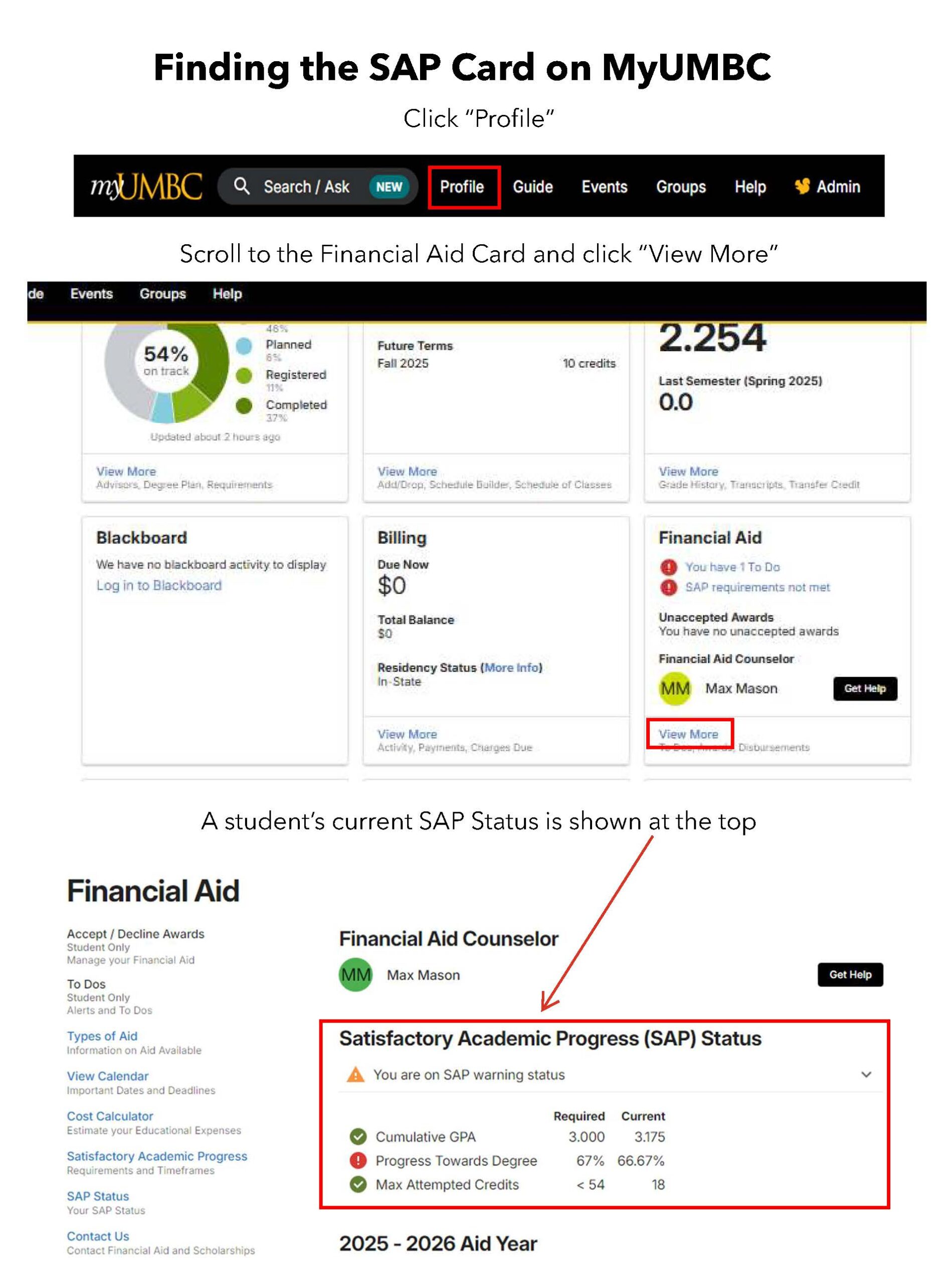
(Click image to enlarge)
How long does SAP restriction or SAP probation last?
Restriction: Lasts until the student is found to be meeting SAP standards during a status calculation or there is an approved SAP appeal is on file.
Probation: If given a probationary SAP appeal approval, probation lasts until until the end of the semester in which the student appealed. At that point the student’s account will be reviewed to determine if a status update is warranted.
For more information, check out the SAP Status and SAP Appeal Process pages!
Are SAP probation and SAP restriction the same as academic warning, probation, and suspension?
SAP probation and SAP restriction is related to a student’s academic performance, but it is not the same as an academic warning, probation, and suspension:
Academic warning, probation, and suspension may restrict a student’s eligibility to register for classes at UMBC, whereas SAP probation and restriction may restrict a student’s eligibility for Federal, state, and institutional financial aid.
I’m on SAP probation but I need to withdraw from a course, what do I do?
Please contact your Financial Aid Counselor if you have any specific questions about deviating from the Academic Plan on your SAP appeal. Withdrawing from a course while on SAP probation may negatively impact your future eligibility for Federal, state, and institutional financial aid. We will help you evaluate your options and best course of action.
Can I receive financial aid while on SAP restriction?
If on SAP Financial Aid Restriction, students are not eligible to receive Federal, state, or institutional financial aid. However, they may be eligible to receive private (alternative) loans, which can be found here.
I am now meeting SAP standards, so can I get aid?
SAP is calculated and evaluated for all degree seeking students at the conclusion of each semester (including summer and winter sessions). If you are found to meet SAP standards at the semesterly calculation, your status will be updated to Meeting SAP and you will be eligible to receive financial aid.
SAP Appeal Process
When do I know I need to appeal for SAP?
Typically receiving many ‘D’s, ‘F’s, and even ‘W’s in one or more semesters can lead to SAP issues. SAP is calculated each semester after grades are finalized and students will be notified of their status via their UMBC email. Students can also track their SAP status on their myUMBC profile on their Financial Aid Card
If a student is worried that their academic performance may cause issues with financial aid, they should contact their Financial Aid Counselor. The counselor can review the situation and provide guidance on best next steps.
What is the SAP Appeal Process?
Please visit our SAP Appeal Process page for a full explanation of the process.
When is the deadline to submit an appeal?
It is recommended that students submit their appeal as soon as possible after they are notified they are failing SAP. The student should take into account that it will take time for both their academic advisor and the Financial Aid office to review their appeal. Appeals will be accepted up until two weeks before the end of the semester the appeal is for.
It is important to consider that some financial aid funds are limited and may be exhausted during the course of the semester, and therefore no longer be available to those who appeal later. In addition, there are cutoffs for certain aid such as federal loans so appeals received later in the semester may not be reviewed in time for students to receive these awards if submission is delayed.
How should I write my appeal?
-
-
- The appeal will prompt you to share what circumstances led you to not meet the standards. You should speak to each semester with unsuccessful courses, not just the most recent semester.
- The appeal will also prompt you to share what has changed that will ensure academic success in the future. Be specific about the changes and how they will impact your academic success.
- See our SAP Appeal Process page for tips and a sample SAP appeal
-
Please contact us if you have any questions before submitting an appeal.
What should I know about the SAP appeal?
-
-
- If you are submitting a SAP Appeal, begin the SAP Appeal process as soon as possible. Completing the appeal packet requires multiple documents, including a meeting with your academic advisor in order to submit the appeal. Appeals must be received at least two weeks prior to the end of the semester in order to be considered.
- Your appeal should be concise but complete, sharing both circumstances and changes.
- Please contact us if you have any questions before submitting an appeal.
-
My appeal was approved. Why do I still have an alert on my account?
An alert will remain on your account until your SAP probationary period ends. See “What is SAP probation?.”
My appeal was approved. What do I need to do in order to keep financial aid eligibility for the next semester?
Depending on why you originally did not meet SAP standards, it is likely that any grade of a ‘D’, ‘U’, or ‘F’ will negatively impact your financial aid for the next semester. Additionally, withdrawing from a class (receiving a ‘W’) may also negatively impact your financial aid for the next semester. Please contact us if you have any questions about how a ‘D’, ‘F’, U, or ‘W’ will impact your SAP status and appeal in the future.
I am an academic advisor and have questions about SAP appeals.
Please see our SAP Appeals: Advisor FAQs page for more information